In our 20s and 30s, the lens of our eye is typically clear and flexible, which allows light to pass through it and our eyes to focus on objects at various distances. However, typically starting in our mid 40s, our lenses naturally begin to harden and become cloudy. This is a natural process called presbyopia which occurs in various stages as we continue to age.

What Is Refractive Lens Exchange?
Refractive Lens Exchange is a surgical procedure in which the eye’s clear, natural lens is removed and replaced with a custom-designed artificial intraocular lens (IOL). While the procedure is similar to cataract surgery in technique, RLE is performed on eyes with clear lenses to correct refractive errors and address age-related vision changes.
RLE is particularly effective for patients with:
- High degrees of nearsightedness (myopia)
- High degrees of farsightedness (hyperopia)
- Significant astigmatism
- Presbyopia (age-related loss of focusing ability)
- Dysfunctional Lens Syndrome (DLS), where the natural lens loses clarity and flexibility with age
One of the most significant benefits of RLE is that it permanently prevents cataracts from developing in the future. Since the natural lens is replaced with an artificial one, you will never develop age-related cataracts in the treated eye.
RLE Hall Of Fame
– “No more readers. It’s unbelievable. One of the best decisions of my life.” – Ian Furness from KJR Sport Radio 93.3 –
Why Choose Aurora LASIK for RLE Surgery?
Aurora LASIK is the leading provider of refractive lens exchange surgery in Lacey, Tacoma, and the Pacific Northwest. Our practice is built on a foundation of clinical excellence, advanced technology, and personalized patient care.
Our Physicians and Their Expertise:

Patrick D. Munson, MD
Dr. Patrick Munson is a board-certified ophthalmologist specializing in refractive and corneal surgery. With over 15 years of dedicated experience in vision correction, Dr. Munson has performed more than 15,000 vision correction procedures, including LASIK, PRK, RLE, and ICL surgeries. His extensive background includes service as the former Director of Ophthalmology Training for the U.S. Army, where he trained military surgeons in advanced refractive techniques and surgical best practices. Dr. Munson’s commitment to surgical excellence and patient outcomes has established him as one of the most experienced RLE surgeons in the Pacific Northwest region.
Dr. Munson maintains active membership in the American Academy of Ophthalmology (AAO) and the American Society of Cataract and Refractive Surgeons (ASCRS), ensuring he stays current with the latest clinical guidelines and surgical innovations.

Anthony Grillo, MD
Dr. Anthony Grillo is a board-certified ophthalmologist with specialized fellowship training in cornea and refractive surgery. His fellowship training focused on advanced corneal and refractive surgical techniques, positioning him as an expert in complex vision correction cases. Dr. Grillo brings a meticulous, patient-centered approach to every procedure and specializes in RLE and ICL surgeries for patients with challenging refractive profiles.
Dr. Grillo is an active member of the American Academy of Ophthalmology (AAO) and maintains continuing medical education in advanced refractive techniques.
What Happens During RLE Surgery?
Understanding the RLE procedure can help you feel confident and prepared on surgery day. The procedure typically takes 10 to 15 minutes per eye and is performed as an outpatient surgery, allowing you to return home the same day. Each eye is treated in a separate procedure scheduled on different days to allow the first eye to begin healing before the second eye is treated.
Step-by-Step Procedure:
- Numbing and Preparation: Your eye is numbed with anesthetic drops, and the surgical area is cleaned and draped. You remain awake throughout the procedure but will not feel pain, only mild pressure.
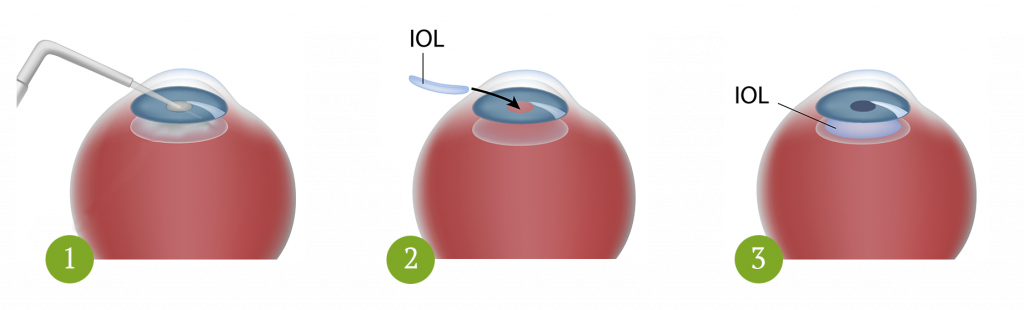
- Corneal Incision: A small, self-sealing incision (typically 2.2 to 2.8 mm) is made in the cornea. This tiny opening allows access to the lens without requiring stitches.
- Lens Removal: Using phacoemulsification (ultrasound energy), the natural lens is gently broken into small pieces and carefully removed from the eye.
- IOL Insertion: A custom-selected intraocular lens is inserted through the small incision and positioned in the lens capsule. The IOL unfolds and settles into place.
- Incision Closure: The corneal incision is self-sealing and typically requires no stitches. Your eye is protected with a shield.
The entire procedure is guided by advanced diagnostic imaging and real-time monitoring to ensure precision and safety.
Intraocular Lens (IOL) Options
One of the most important decisions in RLE surgery is selecting the right IOL for your vision goals. Aurora LASIK offers several advanced IOL options, each designed to address different vision needs:

Monofocal IOLs:
These lenses provide excellent distance vision and are the most commonly used IOL type. They focus light at one distance, so you may still need reading glasses for near vision tasks. Monofocal lenses offer the sharpest distance vision and are ideal for patients who prioritize clarity at one distance.
Multifocal IOLs:
These premium lenses have multiple zones that allow you to see clearly at multiple distances, including near, intermediate, and far. Multifocal IOLs reduce or eliminate the need for glasses for most daily activities. Some patients may experience mild halos or glare in low-light conditions, though this typically improves over time as the brain adapts to the new lens.
Toric IOLs:
Designed specifically for patients with astigmatism, toric IOLs correct both refractive error and astigmatism in a single lens. They can be combined with monofocal or multifocal technology.
Extended Depth of Focus (EDOF) IOLs:
These newer lenses provide a continuous range of vision from distance to near, offering a balance between multifocal and monofocal options with fewer visual side effects.
During your consultation, our surgeons will evaluate your vision prescription, lifestyle, and visual priorities to recommend the IOL that best matches your goals.
Am I a Candidate for RLE Surgery?
RLE is an excellent option for many patients, but not everyone is a candidate. During a comprehensive eye examination, our surgeons will evaluate whether RLE is right for you.
You may be a good candidate for RLE if you:
- Are age 40 or older (presbyopia typically begins around age 40)
- Have a refractive error (nearsightedness, farsightedness, or astigmatism) that is too high for LASIK or PRK
- Are not a candidate for LASIK or PRK due to thin corneas or other corneal conditions
- Have presbyopia and want to reduce dependence on reading glasses
- Have Dysfunctional Lens Syndrome (DLS) with lens-related vision problems
- Have realistic expectations about surgical outcomes
- Are in good overall eye health with no untreated eye diseases
Factors that may disqualify you include:
- Severe dry eye disease (though this can sometimes be managed)
- Uncontrolled glaucoma or advanced glaucoma
- Retinal disease or macular degeneration
- Severe corneal scarring or disease
- Pregnancy or nursing (surgery should be delayed)
- Unrealistic expectations about visual outcomes
The only way to know if you’re a candidate is through a detailed consultation with one of our surgeons. We encourage you to schedule a comprehensive evaluation to discuss your vision goals and determine the best treatment option for your eyes.
In the meantime, you can learn more about RLE candidacy by taking our free quiz.
RLE has been around for over 60 years and is one of the most widely performed and safest vision correction procedures.
Recovery and What to Expect
Recovery from RLE surgery is relatively quick, though complete healing takes several weeks. Understanding the recovery timeline helps you plan accordingly and know what to expect.
Immediate Recovery (First 24 Hours):
- Your vision will be blurry immediately after surgery. This is normal and expected.
- You may experience mild discomfort, scratchiness, or a foreign body sensation. This typically resolves within a few hours.
- Your eye may feel slightly irritated or watery.
- You must wear a protective eye shield while sleeping for the first week to prevent accidental rubbing.
First Week:
- Vision gradually improves but remains somewhat blurry or fluctuating.
- Most patients can return to light activities and desk work within 2 to 3 days.
- You must use prescribed antibiotic and anti-inflammatory eye drops as directed.
- Avoid rubbing your eyes, swimming, hot tubs, and strenuous exercise.
- Avoid getting water or soap directly in your eye during showering.
Weeks 2 to 4:
- Vision continues to improve and stabilize.
- Most patients notice significant vision improvement by the end of the first week and substantial improvement by week 2.
- You can gradually resume normal activities, including light exercise.
- Continue using prescribed eye drops as directed.
- Attend all scheduled follow-up appointments.
Weeks 4 to 12:
- Vision stabilizes and continues to refine.
- Most patients achieve their final vision outcome by 4 to 6 weeks, though some continue to improve for up to 3 months.
- You can resume all normal activities, including strenuous exercise and contact sports.
- Most patients no longer need prescription eye drops by 6 to 8 weeks.
Important Recovery Guidelines:
- Do not drive until your surgeon clears you (typically 24 hours after surgery, but follow your surgeon’s specific instructions)
- Avoid heavy lifting and strenuous exercise for at least one week
- Do not rub your eyes for at least one month
- Wear sunglasses outdoors to protect your eyes from UV light and wind
- Attend all follow-up appointments (typically at 1 day, 1 week, 1 month, and 3 months)
RLE Surgery Safety and Complications
RLE is a safe, well-established procedure with a strong safety profile. However, like all surgical procedures, it carries some risks. Understanding potential complications helps you make an informed decision.
Common Side Effects (Usually Temporary):
- Dry eye (very common in the first few weeks, typically resolves with eye drops)
- Mild glare or halos around lights, especially at night (usually improves over time as the brain adapts)
- Fluctuating vision during the first few weeks
- Mild inflammation or irritation
Rare but Serious Complications:
- Retinal detachment (occurs in approximately 0.5 to 1.0% of RLE patients)
- Corneal edema (swelling of the cornea)
- Posterior capsule opacification (clouding of the lens capsule, treatable with a simple laser procedure)
- Infection (extremely rare with modern surgical techniques and antibiotic protocols)
- IOL malposition (rare, may require repositioning)1
The risk of serious complications is significantly reduced when surgery is performed by an experienced, board-certified surgeon using advanced technology and proper surgical technique. At Aurora LASIK, our surgeons’ extensive experience and meticulous surgical approach minimize complication rates.

Financing Options
RLE is typically considered an elective procedure and is not covered by most insurance plans, including Medicare and private insurance.
Aurora LASIK offers flexible financing options to make RLE surgery affordable:
- Monthly payment plans with low interest rates
- CareCredit and other third-party financing options
During your consultation, our financial coordinators will discuss pricing and financing options available to help make treatment more accessible.
Patient Testimonials and Success Stories
“I visited several places looking for the right fit, and I found it with an Aurora LASIK! They were professional, conscientious, informative, and trustworthy from the start. They treat you with first class service. You aren’t just a number with them!
After considering RLE for over 8 months I finally made the investment and it paid off for sure! Because of aging, I had been using readers for the last 10 years. Now my vision is perfect and they are no longer needed. What a freedom to have again! It’s well worth the investment in yourself!”
– J.P.
Google Review ⭐⭐⭐⭐⭐
Eager to learn more about the RLE patient experience?
Hear from more Aurora LASIK patients.
Frequently Asked Questions
Aurora LASIK is the leading provider of Refractive Lens Exchange surgery in Lacey, Tacoma, and throughout the Pacific Northwest. Our experienced surgeons have performed thousands of RLE procedures with exceptional outcomes. We offer state-of-the-art technology, personalized care, and flexible financing to make advanced vision correction accessible. Schedule your comprehensive RLE evaluation today and discover why patients throughout the region trust Aurora LASIK for their vision correction needs.
LASIK reshapes the cornea using a laser to correct refractive errors, while RLE replaces the natural lens with an artificial IOL. LASIK is ideal for patients with moderate refractive errors and healthy corneas, while RLE is better for patients with high refractive errors, thin corneas, or presbyopia. RLE also prevents cataracts from developing in the future, which LASIK does not. Your surgeon can help determine which procedure is best for your specific vision needs.
Modern IOLs are FDA-approved for permanent implantation and are designed to last a lifetime. They do not degrade, wear out, or need to be replaced under normal circumstances. Your artificial lens will remain in your eye permanently and require no maintenance.
This depends on the type of IOL you choose. With a monofocal IOL, you may still need reading glasses for near vision tasks. With a multifocal or EDOF IOL, most patients can see clearly at multiple distances and may not need reading glasses for most activities. During your consultation, discuss your lifestyle and visual priorities with your surgeon to choose the IOL that best meets your needs.
If your vision changes significantly after RLE, your surgeon can perform an enhancement procedure to fine-tune your vision. This is uncommon but possible. Additionally, if you develop presbyopia in the future (age-related loss of near focusing ability), you may benefit from reading glasses or bifocals, depending on your IOL choice.
Sources
1 American Refractive Surgery Council. Cataract Surgery with Vision Correcting IOLs. Available: https://americanrefractivesurgerycouncil.org/refractive-surgery-procedures/cataract-surgery-with-vision-correcting-iols. Accessed February 25, 2026.