Aurora LASIK is proud to offer advanced photorefractive keratectomy (PRK) surgery to patients throughout Lacey, Tacoma, and the Pacific Northwest. Our board-certified ophthalmologists have helped thousands of patients achieve clear vision without glasses or contacts. If you’ve been told you’re not a candidate for LASIK due to thin corneas, irregular astigmatism, or other corneal concerns, PRK may be the ideal vision correction solution for you. Our surgeons use the latest WaveLight Refractive Suite technology to deliver superior outcomes with minimal side effects.
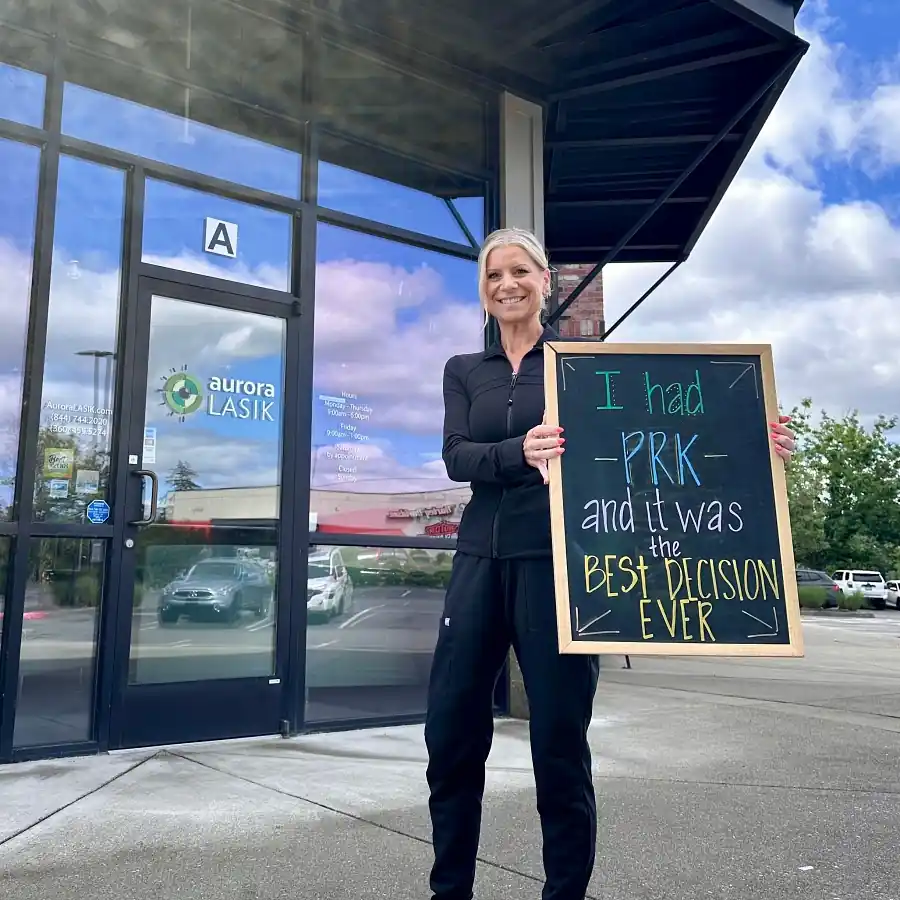
What Is PRK (Photorefractive Keratectomy)?
Photorefractive keratectomy, commonly known as PRK, is a laser vision correction procedure that reshapes the cornea to correct refractive errors such as myopia (nearsightedness), hyperopia (farsightedness), and astigmatism. Unlike LASIK, which creates a corneal flap, PRK directly treats the corneal surface, making it an excellent option for patients with thinner corneas or those seeking maximum corneal preservation.1
PRK was actually the first laser refractive surgery approved by the FDA in 1995, predating LASIK by several years. PRK has demonstrated excellent long-term safety and efficacy, with success rates comparable to or exceeding LASIK in many patient populations.2 The procedure works by using an excimer laser to precisely remove microscopic layers of corneal tissue, reshaping the cornea’s curvature to allow light to focus correctly on the retina. This results in clearer vision without the need for corrective lenses.
How PRK Works: The Procedure Step-by-Step
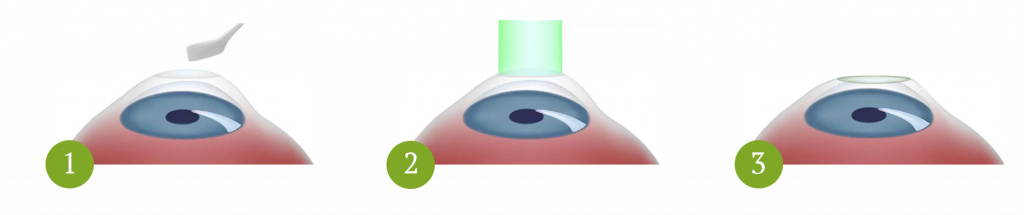
Understanding the PRK procedure can help ease any concerns you may have. Here’s what to expect:
Step 1: Numbing and Epithelial Removal
Your eye is numbed with anesthetic drops, and the outer layer of the cornea (the epithelium) is gently removed using a specialized instrument or laser. This step takes only a few seconds and is completely painless due to the numbing drops.
Step 2: Corneal Mapping
Advanced diagnostic technology maps your cornea’s unique shape and prescription. Our WaveLight Refractive Suite uses wavefront-guided technology to create a customized treatment plan tailored to your specific vision needs. This personalized approach ensures optimal outcomes for your individual corneal anatomy.
Step 3: Laser Reshaping
The excimer laser precisely reshapes the corneal tissue according to your customized treatment plan. The laser uses real-time eye-tracking technology to follow your eye’s natural movements, ensuring accuracy throughout the procedure. This step typically takes 30-60 seconds per eye. WaveLight’s advanced eye-tracking delivers laser precision within 0.25 diopters, resulting in superior visual outcomes compared to conventional laser systems.
Step 4: Application of Protective Contact Lens
A soft contact lens is placed on your eye to protect the cornea as it heals and to minimize discomfort during the initial recovery period. This protective lens remains in place for 3-5 days while the epithelium regenerates.
Step 5: Post-Operative Care
You’ll receive detailed instructions for eye drops, activity restrictions, and follow-up appointments. Most patients experience significant vision improvement within the first week, with continued improvement over the following months.

Who Is a Candidate for PRK?
PRK is an excellent option for many patients, particularly those who may not qualify for LASIK. You may be a good candidate for PRK if you:
- Have thin corneas that make you ineligible for LASIK
- Have irregular astigmatism or keratoconus
- Participate in contact sports or have an active lifestyle
- Have a stable prescription for at least one year
- Are between 18 and 65 years old
- Have myopia between -1.00 and -12.00 diopters, hyperopia between +0.50 and +6.00 diopters, or astigmatism up to 6.00 diopters
- Have no active eye disease or uncontrolled systemic conditions
- Are not pregnant or nursing3
During your comprehensive consultation at Aurora LASIK in Lacey, our clinical team will perform advanced diagnostic testing to determine your candidacy and recommend the best procedure for your unique vision needs.
PRK vs. LASIK: Which Procedure Is Right for You?
Both PRK and LASIK use excimer laser technology to reshape the cornea, but they differ in one key way: LASIK creates a corneal flap, while PRK treats the corneal surface directly. Here’s how they compare:
| Aspect | PRK | LASIK |
| Corneal Flap | No flap created | Flap created and replaced |
| Best For | Thin corneas, active lifestyles, contact sports | Thicker corneas, faster initial recovery |
| Recovery Timeline | 1 week for functional vision | 1-2 days for functional vision |
| Corneal Preservation | Preserves more corneal tissue | Removes more tissue for flap creation |
| Candidacy | Wider range of prescriptions and corneal thicknesses | Limited by corneal thickness requirements |
| Long-Term Outcomes | Excellent, comparable to LASIK | Excellent, well-established |
The choice between PRK and LASIK depends on your individual corneal anatomy, prescription, and lifestyle.
The PRK Recovery Timeline: What to Expect
One of the most common questions patients ask is about recovery. PRK recovery is longer than LASIK, but the results are worth the wait. Here’s a detailed timeline:
Immediate Recovery (Days 1-3)
- Your eye may feel scratchy or uncomfortable as the epithelium regenerates
- Vision will be blurry and fluctuating
- You’ll wear a protective contact lens for comfort
- Frequent use of prescribed eye drops is essential
- Avoid strenuous activity, swimming, and contact sports
- Most patients manage discomfort with prescribed pain medication
Intermediate Recovery (Weeks 3-8)
- Vision continues to improve steadily
- Most patients achieve functional vision (20/40 or better) by week 2-3
- You can resume most normal activities, including light exercise
- Eye drops are gradually reduced
- Sensitivity to light may persist but typically improves
- Return to contact sports typically allowed by week 4-6
Early Recovery (Week 1-2)
- The epithelium typically regenerates within 3-5 days
- Vision begins to improve noticeably
- Discomfort usually resolves as the epithelium heals
- You can return to light activities and desk work
- Continue frequent eye drop use as directed
- Most patients achieve functional vision (20/40 or better) by week 2-3
Long-Term Recovery (Months 2-6)
- Vision stabilizes and continues to refine
- Most patients achieve their final vision outcome by 3-6 months
- Some patients experience continued subtle improvements up to one year
- Regular follow-up appointments monitor healing and vision stability
Potential Risks and Side Effects
Like any surgical procedure, PRK carries some risks. However, serious complications are rare. Common temporary side effects include:
- Dry Eyes: Temporary dryness is common and managed with prescribed eye drops. Most patients experience resolution within 3-6 months.
- Light Sensitivity: Sensitivity to bright light typically resolves within weeks to months.
- Halos and Glare: Some patients experience halos around lights, especially at night, which usually diminish over time. Occurs in approximately 5-10% of patients.
- Fluctuating Vision: Vision may fluctuate during the first few weeks as the cornea heals. This typically stabilizes by week 4-6.
Rare but serious complications may include:
- Corneal scarring (occurs in less than 1% of cases with modern laser technology)
- Infection (extremely rare with proper post-operative care, less than 0.1%)
- Undercorrection or overcorrection requiring enhancement surgery (occurs in 5-10% of cases)
- Regression (gradual return of refractive error, typically managed with enhancement, occurs in less than 5% of cases)4
Our clinical specialists at Aurora LASIK will discuss all potential risks and benefits during your consultation, and we maintain detailed records of our outcomes to ensure transparency and continuous improvement.

Why Choose Aurora LASIK for PRK Surgery?
Aurora LASIK has earned a reputation as the leading vision correction center in the Pacific Northwest. We proudly serve patients throughout Lacey, Tacoma, Olympia, Tumwater, Yelm, and surrounding communities in the Pacific Northwest. Whether you’re seeking PRK surgery near you in Lacey or traveling from across the region, our board-certified surgeons are ready to help you achieve clear vision.
Dr. Anthony Grillo, MD is board-certified by the American Board of Ophthalmology and specializes in corneal and refractive surgery. Dr. Grillo joined Aurora LASIK in 2022 and brings advanced training in the latest refractive techniques and technologies. He is a member of the American Academy of Ophthalmology and maintains active involvement in continuing medical education to stay current with the latest advances in refractive surgery.
We use the WaveLight Refractive Suite, one of the most advanced laser systems available. This technology features:
- Wavefront-guided customization for superior visual outcomes
- Real-time eye tracking to ensure laser precision within 0.25 diopters
- Rapid pulse frequency for faster, more comfortable procedures
- FDA-approved technology with proven track record of excellent safety and efficacy
- Clinical studies demonstrate that WaveLight-guided PRK achieves 20/20 vision or better in 95% of patients, with minimal side effects
Aurora LASIK was recognized as one of the Best of South Sound 2025, reflecting our commitment to excellence, patient satisfaction, and clinical outcomes. This award recognizes our dedication to providing the highest quality vision correction services in the region.
From your initial consultation through your final follow-up appointment, our team is dedicated to your comfort and success. We provide:
- Advanced diagnostic testing to determine candidacy
- Personalized treatment planning tailored to your unique vision needs
- Detailed pre-operative and post-operative instructions
- Convenient follow-up appointments at our Lacey location
- Flexible financing options to make vision correction affordable
Frequently Asked Questions About PRK
The actual laser treatment takes only 30-60 seconds per eye. The entire appointment, including preparation and post-operative instructions, typically takes 30-45 minutes.
Most patients can return to desk work within one week, though vision may still be fluctuating. If your job involves physical labor, contact sports, or exposure to dust or chemicals, you may need to wait 2-4 weeks. Your surgeon will provide specific recommendations based on your occupation and healing progress.
The procedure itself is painless due to numbing drops. However, you may experience mild discomfort or a scratchy sensation during the first few days of recovery as the epithelium regenerates. This is managed effectively with prescribed eye drops and pain medication if needed. Most patients report that discomfort is minimal and well-tolerated.
PRK costs vary based on your prescription complexity and whether you choose standard or custom wavefront-guided treatment. At Aurora LASIK in Lacey, we offer competitive pricing and flexible financing options. Contact us for a personalized quote during your consultation.
Most insurance plans do not cover elective vision correction surgery. However, we offer flexible financing options and can provide an itemized quote during your consultation. Ask about our new patient special and financing programs to make PRK affordable.
Yes, PRK is an excellent option for patients with thin corneas. Unlike LASIK, which requires creating a corneal flap and therefore needs thicker corneas, PRK treats the corneal surface directly and preserves more corneal tissue. This makes PRK ideal for patients who have been told they are not candidates for LASIK due to thin corneas. Our surgeons have extensive experience treating thin cornea patients with excellent outcomes.
Yes, PRK can effectively treat irregular astigmatism. In fact, PRK is often preferred over LASIK for patients with irregular astigmatism because it treats the corneal surface directly without creating a flap. Our WaveLight Refractive Suite uses advanced wavefront-guided technology to map and correct even complex irregular astigmatism patterns. Our clinical team specializes in treating irregular astigmatism and other complex corneal conditions.
Custom wavefront-guided PRK uses advanced diagnostic technology to map your cornea’s unique shape and create a personalized treatment plan. Unlike standard PRK, which corrects basic refractive errors, wavefront-guided PRK accounts for higher-order aberrations (subtle imperfections in your cornea’s shape) to deliver superior visual outcomes. Clinical studies show that wavefront-guided PRK achieves better visual acuity and fewer side effects compared to standard PRK.
Aurora LASIK is conveniently located in Lacey, WA, serving patients throughout Lacey, Tacoma, Olympia, Tumwater, Yelm, and surrounding Pacific Northwest communities. Our board-certified surgeons have performed thousands of successful PRK procedures using advanced WaveLight technology. We offer comprehensive consultations to determine if PRK is right for you, with flexible scheduling and financing options to make vision correction accessible. Schedule your free consultation today to learn how PRK can transform your vision.
Contact Us and Schedule Your PRK Consultation
If you’re ready to explore whether PRK is right for you, Aurora LASIK is here to help. Our board-certified surgeons and experienced team are committed to providing personalized care and exceptional results. Contact us to schedule your PRK consultation.
We serve patients throughout Lacey, Tacoma, Olympia, Tumwater, Yelm, and the Pacific Northwest with the same commitment to excellence and patient satisfaction that has made Aurora LASIK the region’s trusted vision correction center.

1 American Academy of Ophthalmology. What is Photorefractive Keratectomy (PRK)?. Available: https://www.aao.org/eye-health/treatments/photorefractive-keratectomy-prk. Accessed February 20, 2026.
2 Hashmani N, Hashmani S, Ramesh P, et al. A Comparison of Visual Outcomes and Patient Satisfaction Between Photorefractive Keratectomy and Femtosecond Laser-Assisted In Situ Keratomileusis. Cureus. 2017;9(9):e1641. Published 2017 Sep 1. doi:10.7759/cureus.1641. Available: https://www.ncbi.nlm.nih.gov/pmc/articles/PMC5665689/. Accessed February 20 2026.
3 Cleveland Clinic. Photorefractive Keratectomy (PRK) Eye Surgery. Available: https://my.clevelandclinic.org/health/treatments/8596-photorefractive-keratectomy-prk-eye-surgery. Accessed February 20, 2026.
4 Spadea L, Giovannetti F. Main Complications of Photorefractive Keratectomy and their Management. Clin Ophthalmol. 2019;13:2305-2315. Published 2019 Nov 27. doi:10.2147/OPTH.S233125. Available: https://www.ncbi.nlm.nih.gov/pmc/articles/PMC6885542/. Accessed February 20, 2026.